Where do we find inspiration? Sometimes it's by getting an "inside" view on how an image was created. With that goal in mind, I've created a You Tube Video showing how this image went from the original on the left to the finished version on the right. The video is on my YouTube channel, which has additional tutorials on Lightroom and Photoshop. I was inspired both by the travel posters (see below) of the 30's and 40's as well as my love for vintage Los Angeles architecture. Here's a link to the video.
Showing posts with label Photography. Show all posts
Thursday, June 13, 2013
Thursday, June 6, 2013
New Ways to Photograph
Back when I was a little more limber and was teaching a beginning photography class, one of the opening group exercises I would do is to have them stand on top of their desk (luckily we had strong tables) to see how the world looked different. Then we would reverse the experience and everyone had to be on the floor - placing their eyes two inches from the ground. Strangely enough, it was this second viewpoint that was the most unusual.
The whole idea was to take people in their everyday setting and look at how differently you could change things simply by using a different viewpoint. We forget (or never knew) what the world looks like from someone else's vantage point until we're literally placed into it. So today I though I would look at how many of those different viewpoints you can use to change the look of your image-making.
From February's Month of Creativity:
Altitude is the first one and includes everything from a "god's eye" view to an "ant's viewpoint." Think about shooting from ground level up to knee level...to beyond - 10ft above, even thirty feet above. In each of these situations you've got a whole different set of compositional and design options. Don't forget that you can even go below ground level to really change it up.
Scale - shooting details - getting as close as you can. Consider shooting a series of shots that in each step you move 50% closer with each step. See what happens to our sense of the subject as we start to lose our reference points.
Additional methods of changing what happens within the frame:
Time - how an object changes over time. This could be anything from a decaying object to an organic element that grows and morphs. Think of Nick Nixon's great series on his wife and her sisters - photographing them annually over several decades.
Compositional shape - think of the different energies found in a panoramic shape vs. a square frame. By its nature the square, with it's equal sides, is balanced and calm while a pano has a very dynamic energy as it makes the eye move over its landscape.
Tone or light is a way to direct the eye - try creating a shot where the majority of the image is in darkness and the subject becomes an island of light. Do the opposite, fill the frame with light and sketch the subject with only the slightest change in tonality.
Thursday, May 2, 2013
Getting Out...Part II
This week I'm in Palm Springs for Portfolio Reviews. You see these events advertised everywhere now, they've become a new industry...and I guess I have mixed feelings about them. In the past I've attended two other reviews: Photo Lucida, in Portland, is the best of the smaller regional reviews, Fotofest, in Houston, is an enormous, overly intense experience. Each time I attend one of these events I'm struck by the same feelings...it's exhausting (and not part of my nature) to get myself out among so many strangers, all of us trying to make connections.
Over time, I've gotten used to the format of the experience and that has helped. My presentation method has been slimmed down to an easily carried portfolio box. The prints are standardized in terms of the size of the paper and how the work fits on it - basically removing any unwanted distractions. I've got a business card and a solid promotional leave-behind. The "review" is a 20 minute slot during which you've got to find the table, introduce yourself, unpack your stuff, give a short description of the work, have them turn the pages/flip the prints, answer their questions, take a few notes, ask your questions and pack up when the buzzer rings. Fun huh?
I decided to put myself through this process because I felt it was time for this new body of work to leave the studio and start its path into the world. However, now that I'm here, that old uneasiness returns. Part of it is the monetization of what used to be a fundamental part of the art-making experience - talking about your work with curators, gallerists and collectors. That conversation and relationship was a part of how artists developed and how the art world saw itself. I'm left with so many questions: what if your work doesn't benefit from being summed up in 20 minutes...what if it's better to look at all the work laid out at once...what if they've already seen 10 people and their brains are mush?
On the upside, I've met many great photographers in just a few days, which is one of the best end results of these experiences - that connection to a greater group. The Sunday afternoon event was an open portfolio review where all the participants got space to show their work and I thoroughly enjoyed wandering around meeting people whose work I liked and discussing it with them. There was a real mix of expertise levels and that was interesting as well.
So, is it worth it? I don't know...sometimes it's about movement...even when you don't exactly know where you want to go. We'll see...
Here are a few of the photographers I met:
Torrie Groening: she had been a print maker for over two decades and the work I saw was mixed media with layers of painting and photography - you can tell she has a strong sense of how to work with color. I loved the delicate quality of the work. She had traveled from Vancouver, Canada
Wendy Sacks: interesting body of work featuring photographs of children semi-submerged in water. There was a lush quality to the prints and I especially was drawn to the reflections that created patterns throughout.
Bobby Lee: he had both what I would call commercial/glossy fashion style portraits as well as a beautiful set of subtle landscapes. Additionally, he had hand bound his portfolio with pull out pages...very impressive.
Adam D. Gerlach: he was from Santa Barbara (Brooks Institute) and had a beautiful set of black and white intensely dark landscapes. Stylish work, abstracted with good design.
So, is it worth it? I don't know...sometimes it's about movement...even when you don't exactly know where you want to go. We'll see...
Here are a few of the photographers I met:
Torrie Groening: she had been a print maker for over two decades and the work I saw was mixed media with layers of painting and photography - you can tell she has a strong sense of how to work with color. I loved the delicate quality of the work. She had traveled from Vancouver, Canada
Wendy Sacks: interesting body of work featuring photographs of children semi-submerged in water. There was a lush quality to the prints and I especially was drawn to the reflections that created patterns throughout.
Bobby Lee: he had both what I would call commercial/glossy fashion style portraits as well as a beautiful set of subtle landscapes. Additionally, he had hand bound his portfolio with pull out pages...very impressive.
Adam D. Gerlach: he was from Santa Barbara (Brooks Institute) and had a beautiful set of black and white intensely dark landscapes. Stylish work, abstracted with good design.
Thursday, April 25, 2013
Get Out!
I remember having a conversation many years ago with a student about what art-making is - what its purpose is. The student was very involved in her new experience of making imagery but she hadn't realized that just making the work isn't enough to be an artist. It's very easy to get confused between exploring your creativity and actually trying to be a working artist. What's the difference?
![]() |
| 4th Street Bridge, Multiple Viewings |
Bringing creativity into your everyday life is a valuable way to make each day more meaningful. You find yourself surrounded by a world full of wonders and questions...and that's a worthy goal in and of itself - but being a working artist is different in that you're creating something that must find its place in the world. Making art and then just hiding it in your room/closet/studio isn't enough. Art is a commentary about the world/time/space we live in and you owe it to the work to bring it out into the world. Additionally, you don't really know the work until you've seen it in a different environment.
This week I'm stepping out in two very different venues. The first is part of MOPLA which is a month long celebration of photography in Los Angeles. I will be participating in a group exhibition at a "pop-up" space presented by OFFSITE Projects. The exhibition features the work of five photographers all exploring Los Angeles and is called LA Story. I'll be showing work from my Multiple Viewings series which explores the iconic spaces in LA. This is a collaborative effort and we're all pitching in during the four day run of the show. It is located just a block away from Paris Photo, an international photography fair, so we're hoping to get traffic from there as well.
The second event is Connect 2013, The Palm Springs Photo Festival, which starts on Sunday and runs for the week. I'll be bringing a new body of work - Meditative Spaces Found While Traversing The Razor's Edge - this will be its first real journey into the world and I have no idea what to expect. My work (all the different series) has always been about the experience of living, who we are, what we leave behind - but it was always fairly subtle. This new work speaks to the experience of living in a much more solid manner. The images came out of my meditations dealing with change, life, age, fear, joy...you name it...I'm trying to illustrate the human condition. As I said before, it's not enough to just make the work, you then have to bring it out into the world to start to fully understand it - so this is my first step at that process.
LA Story, April 25-28th, 660 N. Larchmont Blvd, Los Angeles
Connect 2013, April 28th-May 3rd, Hyatt Regency, Palm Springs. Come by this Sunday from 2-5 for an open Portfolio event.
Thursday, March 28, 2013
Photography and Invisibility
You may or may not know this, but I teach at a college that has decided, for cost cutting reasons, to discontinue the photography program. There's a lot of directions that I could view this from, but for me, it goes back to the invisibility of photography.
When I was in my teens, like most people I had no idea what I wanted to be when I grew up. Of course I'm still waiting to feel grown up, but that's another post. It was really just by chance that I stumbled into a job as a photographer at the University of Chicago Billings Hospital. I started as a projectionist (it's a teaching hospital) and the only way to get a pay raise was to become a photographer. Fortunately for me, the photographers there liked me and embarked on training me for the job. I learned how to do everything from photograph dead bodies to run a color line. I remember being surprised that a job didn't have to be something you were disconnected from. It opened my mind to understand the difference between having a job and a career. That you could find something that was interesting and fit who you were in life - that you felt really "you" when you were doing it.
A few years later I moved back to Cali and decided to pursue photography and get a degree. I remember telling my grandmother I was going to college to learn photography and she looked at me...laughed...and said, "Why would you want to do that? Nobody needs to have their picture taken." About the only thing she could connect it to was the Sears Portrait Studio. She was surrounded by images, loved magazines and had tons of cookbooks...but the invisibility and ubiquity of photography made it invisible to her. It's a very sad truth that I heard this same reference last month...from an administrator at my school.
We have a son who works at a very large hotel chain in the bay area and he was telling me that one year they sent every hotel a really nice camera saying "from now on, you're taking your own photos." It was a complete disaster, not only for the fact that none of them knew how to operate the cameras, but the fact is cameras don't take pictures by themselves and amateurs usually take amateurish photographs in professional settings.
So here we are in 2013 and we still face the same issue. Photography is completely embedded in the fiber of our being, so many of us use it and yet we don't understand there's more to it than the camera - or software. Taking an interesting image can happen in an instant - but making interesting images, day after day, to meet specific needs on a deadline is a skill that takes years of training to develop (pun intended) and it's foolish to think otherwise.
Here's an interesting article from the NY Times on the rise of photography...too bad my school doesn't have the same vision...
Thursday, March 14, 2013
Give Yourself a Photo Assignment
A few months ago I was up in Northern California doing something I enjoyed - helping my mom out - but it left me a bit cut off from my usual sources of activity and after a couple of days I got a little bored. I soon realized however that if I'm bored, that's my problem so, I decided I'd take charge of my life, go explore a nearby town and give myself a photo assignment. When I worked commercially, that's how the flow of my life worked...I went from one assignment to another. Every once in a while, it can help to "pretend" you're on assignment.
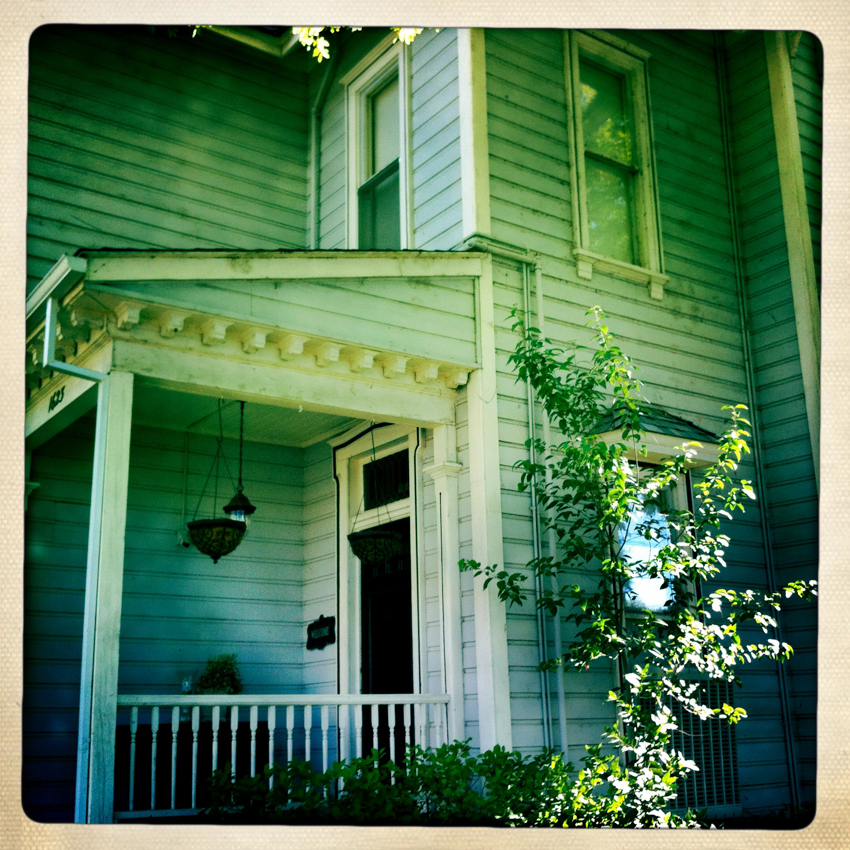
In this situation it turned out to be a good way to add some structure (and control) to my life, and half way through my project idea I realized there was a better one staring me in the face... and this is it - the Homes of Oroville. Oroville is one of those towns that time left behind. You can tell it was once a vibrant place - but over time its fortunes have changed. I see it now trying to make a comeback, starting with a very interesting series of downtown structures that are surrounded by beautiful, gracious homes.
Thursday, January 31, 2013
Is it selfish to be an artist?
I always feel a little selfish as I walk back to my studio - because I literally have to leave the house, and everyone in that house, to go out and work. This can definitely run against one's natural instincts to want to be there for others. I go in, spend time on the computer, process film - somehow these things aren't too troublesome. But what about the larger (and essential) tasks, such as scheduling a day to go shooting - this has occasionally made me worry that I was being selfish...especially when my son was young.
A few weeks ago I became interested in how the light would look at the end of the day on the coast. I had done an earlier image that I liked a lot and I was also interested in photographing the water from different directions. So those were a couple of the goals that had been bouncing around in my brain for a week or so. The problem was when I would go out to the coast with family or friends, we'd be doing other activities and I just didn't feel I could take that time for myself. As an artist, we often need a lot of internal space to really ruminate about an idea - and that can get awkward when you're with others.
So, this week I decide to get past all those worries and make a commitment to making art without guilt! I decided to reserve a day on the calendar just for me - something that was easy when I worked commercially because I could justify it by the lovely fact that a client would be showing up and paying a bunch of $$ for the experience. Unfortunately too often when it's your own work, whether as a fine artist or what ever kind of creative work you do, it's harder to give yourself that credibility. But the fact is, it's okay to take yourself seriously, in fact, if you want to accomplish anything, it's a necessity. Today, take out your calendar and schedule some time for the activity that makes you know who you are!
p.s. Please join me starting Friday, February 1st for an entire month - 28 days of creativity. I'll be doing a daily post with creative exercises and prompts to help jumpstart 2013 as your year of living dangerously!
Thursday, January 3, 2013
The Future of Photography
I love L.A., or at least my visual corner of it. This is a city made of fantasy, and that's where I find my inspiration - in this delicious mix of style and fantasy. An avid film lover, I cut my visual teeth on a combination of Blade Runner, One from the Heart and Fool for Love. Those films fascinated me in their ability to start with threads of the "real" and then build their own vision on top of that. Ten, fifteen years ago, it was unusual for a film to create a new visual world - now it's the norm...often whether we know it or not. Our vision of the world is slowly being remade to blend the divide between what we know to be real and what is not.
Recently I read a review of the film Lincoln and it occurred to me when they discussed the visual approaches used ("the smaller, plainer America of the mid-19th century evoked by the brownish chiaroscuro of the cinematography") that this is the new frontier of visual communication. Our recent dialog in photography has focused on film vs. digital...but I think we were missing the boat on that one. We should have been exploring the much broader world that digital was leading us to - a massive break from the age-old connection between photography and representation. By making the capture digital, we forever broke the idea of "image as documentation" and instead moved into a world where all is equal...copies, edits, composites...they are all originals, they can all feel "real."
Also, along the way, digital removed the photographer as technology's gate-keeper, since now anyone can take an image. When you add the boom in social networking and the life-changing explosions of smart phones and tablets...it has remade the world we live in. In many ways, video games are setting the pace with their visions of dystopian alternative realities while opening up our expectations of what images should accomplish and how our environments could look.
So, what do I see as the future for photography...or photographers? Our future (or one of our futures) is to push the boundaries of what our world looks like, with a vision that gives texture to each frame.
Here are a few photographers I think are worth watching:
Erik Johansson: Many of these guys are also retouchers...he's one of the best with a nice sense of humor.
Dariusz Klimczak: Wonderful work, interesting characters.
Rocky Schenck: I've loved his work for ages, strong sense of place and mood.
Alison Carey: Both a photographer and sculptor, she creates new worlds and then photographs them beautifully.
Thursday, December 13, 2012
The Road Less Traveled
One of the things I love is shooting in the rain. Part of what appeals to me, and why I realize my images look different when I do, is that usually people don't shoot in the rain. They don't want to get their cameras wet - they don't want to get wet themselves - so the majority of the images we see don't come from that experience. It's part an approach I think of as finding the "road less traveled" as a visual artist.
There have been some very interesting approaches to this concept. The most obvious photographic one is choosing to shoot at night. One of my favorite images is a Michael Kenna shot of a Paris bridge at night. We're so used to seeing these things during the day, that just changing that single element creates a new visual palette. One of the things that really made Michael Kenna's work interesting is not only did he shoot at night - he made it look as if it were daytime. By using very long exposures he was able to flip our sense of where the light came from because, in actuality, during his exposures the light would be coming from multiple locations over time. His process compressed time into a single frame and he created a new visual aesthetic as we were able to see time, such as the ocean's movement over eight hours, compressed into a single image.
Another example is Susan Barnett whose project Not In Your Face photographs the backs of people. We're so used to thinking that what's important about people photography is the face - right? Instead, she chose to use the backs and in the process came up with a very interesting way to talk about people and their identities by removing our typical viewpoints.
My challenge for you today is to take the path less traveled, in terms of how you approach image-making. If you feel like you're at a stumbling block trying to come up with something - consider writing it out. Literally write down the elements that you've been choosing and flip that script. Do you like shooting the zoo when it's full of people? Change one element and try shooting it completely empty. If you're still really new as an artist - then pick someone whose work you admire and do the same exercise with their work.
Thursday, November 15, 2012
Can Instagram Make You More Creative?
Like the title asks, can Instagram make you more creative? I don't mean that it comes up with the ideas for you, but with all these programs that supposedly "enhance" your images, it's important to understand that there are significant differences between ones like Histagram vs. ones like Instagram. That difference can become a useful tool.
With Histagram the choices are being made for you - even if you put it on the less "random" setting, you're still using its muscle to create the strength of your image. Whereas with a program such as Instagram, you're taking a picture and applying various changes. The changes really just give you previews of potential pathways - but you're in charge.
There used to be a great function in Photoshop called "Variations." You'd open up an image in its dialog box and you'd automatically be given a preview of the image with a wide range of color and contrast changes. It allowed you to previsualize what would happen if you added more warmth or cooled it down. It didn't go beyond that, but it was a great function and I missed it once it was gone.
I think that's what I like about Instagram and plug-ins such as Alien Skin's Exposure software. They give you the ability to take your image and use it as a sketch, or a foundation, to see where you could go from there. That's what's fun about Instagram - it gives you that previsualization - it can show you a whole set of variations with visual approaches you might never have thought to make.
The above image is a really good example. I had a very specific idea (I seem to start with a lot of those) about what I wanted the image to look like. It wasn't until I was going to "test" it out on Instagram (to see if anyone thought it was a real location) and I was hitting the different filters, when all of a sudden I saw a great direction. Instead of a deep heavy moody aesthetic that many of my images use - I saw a very low contrast, fairly warm and slightly textured approach. I had never thought of doing that before and loved it.
One of the things that people liked so much about film is that it truly gave you unexpected surprises - and that's something that's really less interesting about digital - you can bring it into Photoshop...but it's harder to have a "happy accident."
So I love any situation where I can get out of my head and look at something through someone else's eyes - and really that's what programs like Instagram are. They "filter" your image through someone else's aesthetic. Doing that gets you to a point where you might be open to choices that you have never made before. It's a bit like "It's A Wonderful Life" where he gets to see what his life would have been like - well in a way, you get to see what your image would have been like if it was taken by ten other people - and incorporate that.
These programs give you the ability to ask yourself a wide range of questions:
Do I like that? Why?
What is it about the contrast level?
Do I like seeing in the shadows, or do I not want to see into the shadows?
Do I want mid tones?
What should happen in the highlights, should they be blown out?
Should they have texture in them?
What about the tone? Should I stay cold because that's what it was?
Should I stay neutral to take away the subjectivity?
Should it be warm because it has a more human touch to it?
Used as a tool, these programs give you the ability to figure out what you value and why - and by figuring those things out - I think you're on the road to becoming a more creative artist.
p.s. To try variations in Instagram and save them to your Camera Roll - but not post them...switch your iPhone to Airplane mode (just remember to delete the "failed" shots from Instagram before you switch back.
Thursday, November 8, 2012
You know you're a photographer when...
Between storms and elections - it's been a stressful few weeks - so this week I figured we could all use a bit of humor...
You know you're a photographer when:
You save old shoeboxes just in case you might want to make a pinhole camera.
You have more than 10 photo apps on your phone.
You "fake" some of your Instagrams with your 5D.
At a party, you start talking geek with a friend and realize everyone else is totally bored.
You're seriously considering learning wet-plate.
You used to shoot with zoom lenses, now you mostly use a fixed/prime, and it's often wide-angle.
You've made a roadtrip to the Salton Sea.
You have a laptop, desktop, iPhone and maybe an iPad...and often are
using at least 3 of them at the same time.
You have a tripod in your trunk...and you lust after a gitzo.
You have out-dated film or (better yet) Polaroid in your fridge.
The smell of fixer makes you nostalgic.
You're sick of the photographer being the psycho in movies.
You keep looking for the perfect camera bag. This gets worse if you're a woman,
because you also want to use it as a purse.
You make a lot of u-turns.
You cringe when you see a 5D in the hands of someone other
than the photographer at a wedding.
You've made your friends jump for a photo.
You've included your feet or shadow in a shot on purpose.
You've got to figure out where the light reflecting on the wall is coming from.
You once mistook a lighting strike for a really big strobe.
Gradation filters used in movies & tv shows make you crazy.
You think it would be cool if in the future they figured out how to take pictures through your eyes.
You notice when something's 18% gray.
Your Lightroom catalog has almost no family photos, but tons of shots of
that cool town you found in the desert.
You've taken a detail shot of a plant.
At twilight you often think "you can't get this on film."
You won't eat at places with ugly lighting.
You're addicted to making panoramics.
You keep shooting cloud pix...even though they never look as amazing later.
You're addicted to making panoramics.
You keep shooting cloud pix...even though they never look as amazing later.
Your pet is sick of posing. So are your kids. So is your spouse.
Hope some of these made you smile...if so, congrats - you're a photographer!
Thursday, September 20, 2012
Reaching Out - The Importance of Community
Do you often wish you had the same sense of community that you had in college? That wonderful ability to wander from studio to studio and discuss art...or just hang out?
The hardest part of being a working artist (or other independant creative) is the sense of isolation from the rest of the world. That feeling of being a "lone wolf" may not be the best thing to keep you moving forward in your career. I know with Facebook and other online social sites we can connect digitally, but I've found it's not the same as that in-person connection.
A few years ago, I started a photo-critique group which met every month or so at my home. The group started when I returned from Photo Lucida in Oregon and emailed every participant from the So Cal area. It was a very good experience, lasted for a good 3-4 years and brought me a much larger group of friends and colleagues. Like most organized activities, it languished when I got too busy to dedicate more time. But, while it was going, I found it a good nudge to make sure I kept making images. I also found the critiques extremely helpful when trying to edit my own work.
In New York there's The NY PhotoGroup Salon which meets the third Wednesday of every month and reviews the work of a rotating group of photographers. It started in one of the founding member's studios...apparently this was back in the day when the studio had a chef who made amazing food for the meetings...and now meets at the SoHo Photo Gallery. I heard about it through Bill Westheimer an inventive photographer I met years ago at Photo Lucida.
There was an interesting article in the NY Times that Dan Shepard (see post from 6.28.12) brought to my attention on Photo Collectives which discussed a variety of approaches, everything from groups that are fully enmeshed both financially and creatively, to those that work much more informally. The article stated that this has been a natural response on the part of photographers to give themselves a bigger voice in the world.
In my conversation with Dan he talked about creating a photo-collective and described his idea of the perfect collective. He felt the biggest issue is really the amount of pre-planning that's involved - since it's very important to discuss and plan out what the goals and vision of a group would be. While it's great to have a group of people to share expenses with, it seemed to him that the format also gives the possibility to have a bigger voice on topics they feel are important. The big issue is really making sure you have a group of people who are committed to the collective, even when it's not their specific work that's being shown. It's not enough to just join...you need to really be a part of it.
I'd like to start my critique group back up - but more than that, I'd like to find a group of like-minded individuals would be oriented to the business end of photography - really getting careers going. I'd want to be able to sit down and define our goals, be very hard-headed about our time and see if using the power of the group could work for me.
What kind of a community are you going to start?
Thursday, August 30, 2012
Creativity: Can Less Be More?
Once you have an idea, should you just tap that well until it runs dry? Will it increase the amount of ideas you have on a regular basis...what if you tried a very different approach? You might be surprised that the idea of limiting creative output interests me.
Years ago, I was fortunate enough to stumble upon the perfect (for me) photo project. It was Val Verde, a faded Montecito estate that was just starting a renewal process after years of slumber. I was given full run...completely unshackled by any restrictions - actually that's not totally true - they had a signature view of the stairs I was not to take...very "Garden of Eden."
The project was the culmination of all my interests at the time: beauty, architecture, how people live, old California. It became a very conscious choice on my part that I would limit how much I shot on each visit. A big part of this was a desire to work in a different method. I had just come out of a commercial career (foodie photog) and when I added my schooling on top of that - it felt like I'd spend two decades working as a hitman. Show up - get total coverage, and then get out... So I consciously chose to take a different approach with VV. Instead of coming in day one and covering the joint, I would limit my output to one box of Polaroid film (I was shooting 4x5 Polaroid negatives, which is 20 sheets). This would force me to slow down, take the place in, get to understand it, and myself, as we both evolved over time. I think it was a successful process - and it gave me a chance to grow in a different way as an artist.

My lovely Val Verde project became a book...at the time I felt I should honor their single restriction as part of the trust I'd been given. However, a few years ago the estate fell into bankruptcy and was sold multiple times. For all I know, that signature view is gone...and I wish I'd at least gotten it on film. Here are more of the images from the project.
Creative Challenge: find a place, object person...a subject matter that you're drawn to, and then choose a time span. Maybe for 90 days you're going to take a single shot of it a day - this could be changed in so many ways, but the basic groupings are Time, Subject, Method of Capture or Output - this practice could be interesting in other genres as well - a writing assignment, drawing, poetry...anything, but the main idea is to allow yourself and the subject time to grow together.
This post was inspired by an experience I had while reading Patti Smith's book Just Kids. I was struck by an idea (on a totally unrelated subject) and immediately afterwards I got this feeling "I should stop reading once I get my idea." Maybe I just like to savor great moments...
Thursday, August 16, 2012
Money Does Not Equal Creativity
When you think about people's early films...there's a certain zest to them at that point and I think part of the reason is it really is important to have to deal with compromises in creativity. When you have every resource available to you, it often means that all you do is follow your first path, the first thing you thought of and you lose the magic of discovery.
Here's a good example - I was in a Kamikaze show, which you can read about in this previous post - and I knew I really wanted to do something different, still tied to who I am and what I do, but with a different quality. I wasn't quite sure what that was, but I knew it was out there somewhere. I also knew I didn't want it to be about a traditional approach to photography, where you take the image and then you put it in a frame...I didn't want it to go there.
I've always loved handmade papers and I think a good technique when working creatively is to drift towards the things that inspire you. With paper, I love the tactile quality of it...especially handmade paper - I love the irregularity of it. I'm still amazed that we live like Pharaohs...think about how hard it was for the average person to be able to record their thoughts or create something on paper...anyway...I digress.
As I said, I had this idea...I really wanted the image to almost come "through" the paper...I was thinking it should be very light and so I tried some great handmade paper that I'd had for ages, found an image and ran it through. Initially it wasn't impressive - but then I saw it back lit, with the light coming through it ... it was just astounding. "OMG this is what I'm going to do, I'm going to do these images and then I'm going to put them on light boxes." Then I thought "OMG, where am I going to get a bunch of light boxes? I called around to see if I could rent them easily - I didn't want to spend a ton of money. The show needed to be a creative endeavour, I didn't want it to be about "Oh, let's drop another grand."
So...I kept working and eventually moved into a different kind of image. I've always loved the way a bed looks in the morning, before it gets made, where it has that imprint of what happened that night. Loved the abstract quality of it as well...it's just sort of this shining thing. I thought, "okay great, I'll photograph that and just print it really light as if the light was coming through it." So I did a couple of those...and it just didn't move me either. Finally, taking some of my own advice, I thought well, what if instead of making it very light, I make it very dark, I just sink it into the paper instead of wanting it to lift out of the paper. I did the first print...and it was love instantaneously.
I'm really happy with my new direction and you know, if I had unlimited funds...I would have just sent some of "daddy's money" over to make light boxes. That's why I think it's important to have restrictions. They make us more creative...they make us come up with more solutions. You don't find salvation through a new lens, computer...whatever, you find it in the everyday struggle to deal with the realities life sends us.
One of my happiest re-discoveries in this process was the paper shop McManus & Morgan Paper. It's located over by McArthur Park in LA. Gary Wolin is the owner and here's a great video, Ink&Paper, about his business and the Aardvark Letterpress next door - which is the last letterpress printer in LA.
ink&paper from Ben Proudfoot on Vimeo.
One of my happiest re-discoveries in this process was the paper shop McManus & Morgan Paper. It's located over by McArthur Park in LA. Gary Wolin is the owner and here's a great video, Ink&Paper, about his business and the Aardvark Letterpress next door - which is the last letterpress printer in LA.
ink&paper from Ben Proudfoot on Vimeo.
Thursday, August 9, 2012
Pretending I'm in Paris
In college I had a friend who used to say "I love sitting in the cafeteria, drinking coffee, pretending I'm in New York, and I love sitting in New York, drinking coffee, pretending I'm in Paris." My weekly ritual involves going to Porto's in the morning, drinking coffee and pretending I'm in Argentina - Porto's has a stronger latin vibe.
There's no denying that there's this mystique about Paris, a hold-over from a Hemingway era - that was where you went to become an artist - to really break free and become something new. Even now, I wonder if I should be living somewhere else - what if I moved to San Francisco (as close to Paris as Cali gets)? Would life be better? Would my art career suddenly take wings? Would I break free from my pre-conceptions and become the totally new 2.0 version of me?
Is there something wrong with pretending I'm somewhere else? I do it most of the time, because let's face it, Burbank isn't that exciting and for some reason L.A. lends itself to pretending to be somewhere else. The fact is I'm okay with living in L.A., but I don't really live in the "real" version of it. I'm always hunting for some romantic idealized "noir" past and I know I'm not alone. There's the Blade Runner version of a melting pot distopia, the Heat version of late night isolation and, my favorite, the Double Indemnity version of the valley with its hills, palms and Spanish Revival architecture.
Does it matter where you live? My step-daughter moved to New York after graduation and it's truly the right place for her - she lives a lovely hipster life in Brooklyn and you can feel the energy she gets from her surroundings. But what about the rest of us that can't pull up stakes and move - how do we work our lives so that our environment feeds us?
The french have a term terrior, which means "from the land." It's used to describe how a specific location can impart a characteristic to wine. It's a fairly ancient belief, that location, climate, and soil leave an imprint. So where we live really does make a difference - and maybe it's important to feel more grounded and think about how where you live leaves its mark on you. I'm still very moved by that older version of L.A. and that's what get's me up and out each week shooting and finding new ways to tell its stories.
On the other hand, I'm still going to Porto's and imagine the broad boulevards of Buenos Aries are outside filled with beautiful, cosmopolitan Argentinians.
Labels:
Art,
Home,
Imagination,
Mental Mapping,
Noir,
Photography,
Terrior,
Work
Thursday, August 2, 2012
Finding Inspiration...Martin Lewis
Several months ago I received some very good news, that my "shoot for the moon" project had been approved...my first reaction...a bit of good ol'fashioned panic. Yes, it had been something I'd wanted to do for quite a while. Yes, I believe I do have the basic skills for it. But the real question remained, it was a big creative challenge, and how to you accomplish a creative challenge? How do you create something new (at least for you?).
As I've written in my About sidebar, the title for this blog came as a response from a friend to my question "what am I going to do", and her response was "just start with the first image." So often, that's the problem with tackling a new idea or finding a new direction. You can't take on the entire mountain, you've got to break it into small steps and can really only look just in front of you to the first guidepost.
For me, I'm still exploring how to get started with my project so I'm trying a very wide range of things. My first step is to move intuitively towards whatever I'm drawn to. If it's a location - I go there, if it's an artist - I get a bunch of books of their work and start reviewing them. Now that we have Google, it's so easy to find artwork and I started doing searches on words that interested me and then saving images from those listings.
One of the interesting artists I came across is Martin Lewis. A great side note on googling that name is I got completely sidetracked into the Rat Pack...
Anyway, I completely fell in love with his sense of highlight and shadow and the way his images seem to tell a story about an individual even though it's within the context of a large city. If you see similarities between his work and Edward Hopper - you're very insightful - they were friends and Hopper turned to Lewis for instruction on his etchings. I see a lot of similarities between the two artists. This image, Late Traveler, on the top left, really reminds me of the Hopper painting New York Movie (below). Something about the quality of light and the composition - once again that separation between the enclosed smaller space and the larger world.I don't really know yet how, or if, these artists I'm researching will impact my larger project, but I do see their impact on a series I started with my vintage Tower camera (image below). I love the sense of isolation within the images and I'm drawing on Lewis' aesthetic of a warm tone, with a lot of expanded tonality and deep shadows.
So...maybe...it's a start...
Thursday, July 5, 2012
Change and Being a Photographer
Tomorrow is my birthday...woohoo...but seriously, I'm wondering how I ended up all the way down this road. I was sure that by twenty-seven I would feel like a grown-up and have it all figured out. Yeah... Right... Hmmmmmm.
I got into photography in a very strange way. It was at the University of Chicago, Billings Hospital. I'd been hired as a projectionist because Billings was a teaching hospital and they showed a lot of slides. It could often be pretty dry stuff - and occasionally, I'd hear "next ... next ... NEXT" because I'd dozed off to slumberland amidst slides of rare bone disease. Eventually, this grew boring and the only way to get a pay raise was to move to a different job - and the only opening was as a photographer. What a cool gig! I did everything from process film (E2 line) to photograph architecture. It was the first time I realized that you could have a job that wasn't boring - hell, it was completely different almost every day.
Shortly after this job I ended up returning to school and studying photography. At that time, the process of becoming a good photographer involved studying with the best you could find, and then spending the next several decades perfecting those skills. Now, it's a much different gig, much more like surfing. You grab a wave and ride it for a while...then you've got to work to get back out to the next one, ride it in...and so on. It's not too bad for me, I really get bored quickly, and like learning new things.
The question is often asked, what's next for photography? In some part, that's why I'm doing this blog, it's part of my search for new ways to define what I'm doing (and what I should be teaching). I think the biggest change is that we're not going to be narrow anymore. The new creature that calls themselves a photographer will be a "jack of many trades." They will have to embrace change, and spend more time looking forward than back.
In my interview with Dan Shepherd, he mentioned an interesting quote on conservation. "Conservation is the process of managing change." There's more to it, of course, but I think it applies to photography as well. A big part of being a photographer used to be as a gatekeeper for technology - but in many ways that was because being a photographer was about the camera. Our energies must shift and I believe photography is now about managing the changing visual world around us. Yes, this will involve integrating various technologies, but how we tell our stories, where we focus our energies - that will still remain our most important role. Consider it a given that the method in which those activities happen will change, and continue to change, so there's no point in worrying about it.
On the wall in my studio I've taped up the last Calvin and Hobbes comic strip. They've woken up and found that it had snowed the previous night.
Hobbes: "Everything familiar has disappeared! The world looks brand new!
Calvin: "A New Year! A fresh clean start!
Hobbes: "It's like having a big white sheet of paper to draw on!"
Calvin: "A day full of possibilities!"
Calvin: "It's a magical world, Hobbes ol' buddy...let's go exploring!"
Frankly, that's how I intend to experience this next year...let's go exploring!
Subscribe to:
Posts (Atom)